Lesson · Paper Money
Quran 18:19 · Surah Al-Kahf · 610 CE
A 1,400-year-old verse casually mentions a monetary concept the entire world had yet to adopt.
The verse - People of the Cave wake after a long sleep
فَابْعَثُوا أَحَدَكُمْ بِوَرِقِكُمْ هَٰذِهِ إِلَى الْمَدِينَةِ فَلْيَنْظُرْ أَيُّهَا أَزْكَىٰ طَعَامًا
"Send one of you to the city with this paper money of yours, and let him see which food is most suitable and bring you provision from it."
Why this single word is extraordinary
The Arabic word وَرِقِكُمْ (warikukum) comes from the root وَرَق (waraq) - meaning paper, leaf, sheet. It is the same root used in Arabic today: ورقة means "a piece of paper."
The Quran does not say فضة (silver) or دينار (gold coin). It says paper money - as if the characters already know exactly what it is. This detail is narrated without explanation, without introduction. It is taken for granted as ordinary.
Historians record the first documented paper currency - the Chinese Jiaozi - as appearing in the 11th century CE, roughly 400 years after this verse was revealed. Yet the Quran spoke of it as a known reality.
In 7th-century Arabia, every merchant paid with metal coins. What is the precise Arabic word the Quran uses in 18:19 for the means of payment - and what does it mean?
Currency words in 7th-century Arabic
فِضَّة
silver
دِينَار
gold coin
وَرِق
Quran 18:19
A
فِضَّة (fiḍḍa) - silver, the most common medium of exchange in 7th-century Arabia and the surrounding world
B
دِينَار (dīnār) - the gold coin used across Arabia, Persia, and Byzantium; the universal trading currency of the era
C
وَرِق · بِوَرِقِكُمْ هَٰذِهِ
Root: و-ر-ق · Arabic lexicon: paper, leaf, sheet
Wariq - the word the Quran uses. Not a coin word. Not a metal word. Its root literally means paper or leaf - the same root as ورقة (a piece of paper) in modern Arabic. No 7th-century merchant would use this word for a transaction. It simply was not in the monetary vocabulary of the time.
The Quran mentions paper money as if already known. Historians record the Jiaozi as the first documented paper currency. What does this gap tell us?
The Jiaozi · First Documented Paper Money in History
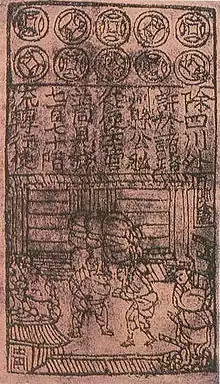
Jiaozi banknote · Song Dynasty China (960–1279 CE). Numismatists regard this as the first documented paper currency in history - emerging from Chengdu, Sichuan. It postdates the Quranic verse by approximately 400 years.
Quran speaks of it
610 CE
as a known, ordinary reality
▼ 400 years of silence ▼
World first documents it
~1000 CE
Song Dynasty · China
A
The Quran borrowed the concept from China - Arab traders had long-distance trade routes that may have introduced the idea
B
It was a coincidence - wariq could simply mean silver coins, and scholars misread the translation
C
The Quran refers to paper money as an already-known reality 400 years before the world's first documented example - indicating knowledge that could not have come from 7th-century Arabia's economic environment
وَرَق = paper in every Arabic dictionary · not a variant word for silver or coin
The Bible's Book of Chronicles (1 Chr 29:7) says King David collected "10,000 gold darics" for Solomon's temple. Why is this significant when compared to the Quran's reference to paper money?
The Biblical daric problem
The daric was a gold coin first minted under King Darius I of Persia, who reigned from 522–486 BCE. Yet 1 Chronicles attributes it to King David, who lived approximately 400–500 years earlier. Historians call this an anachronism - the author used the currency of their own era to describe events from a distant past.
A
Both books made the same kind of error - using monetary terms from their own era carelessly, proving both are human compositions
B
The Bible's anachronism proves its authors had historical knowledge gaps, but the Quran's paper money reference was just a lucky guess
C
The Bible's error shows a human pattern: authors accidentally insert the currency of their own time into past events. The Quran does the opposite - it inserts a monetary concept 400 years ahead of its own time, something no human author would do. One shows human limitation. The other shows knowledge beyond the era.
1 Chronicles 29:7 · daric anachronism · documented by historians
Lesson complete · +30 XP
0
Years the Quran preceded the world's first documented paper money
بِوَرِقِكُمْ
"With your paper money" · Quran 18:19
0
CE - Jiaozi, first documented paper currency
The pattern that separates human writing from divine
Human authors (Bible)
Insert currency of their own era into past events → anachronism (darics in David's time)
The Quran
Mentions a concept 400 years ahead of its time, casually, without explanation → precision beyond the era
Wikipedia · Jiaozi (currency)
"Jiaozi was a form of promissory banknote which appeared around the 11th century in the Sichuan capital of Chengdu, China. Numismatists regard it as the first paper money in history, a development of the Chinese Song Dynasty (960–1279 CE)."
Summary and recap.
Revealed in 610 CE, the Quran narrates the story of the People of the Cave (Surah Al-Kahf 18:19). When they wake and send someone to buy food, they say "take this paper money of yours" - using the Arabic word وَرِق (wariq), rooted in وَرَق meaning paper. The same root is used in modern Arabic for "a sheet of paper" today.
This matters because historians regard the Chinese Jiaozi (Song Dynasty, ~11th century CE) as the first documented paper currency in history - emerging roughly 400 years after this verse. The concept of paper as money was unimaginable to any merchant, scholar, or ruler in 7th-century Arabia. There was no model to copy, no trade route that carried the idea, no precedent anywhere in the known world.
Compare this with the Bible's Book of Chronicles (1 Chr 29:7), which attributes gold darics to King David - a coin that did not exist until 400 years after David's era. Human authors unconsciously insert the currency of their own time. The Quran does the opposite: it inserts a monetary concept its own era had never seen. Not an error of time. A window into knowledge that transcends it.